Validation of Wind Noise for Class-8 Truck Using Lattice Boltzmann Method

Aug 29, 2025·
Nicolas Fougere
Nicolas Fougere
,
Guleria et al
· 0 min read
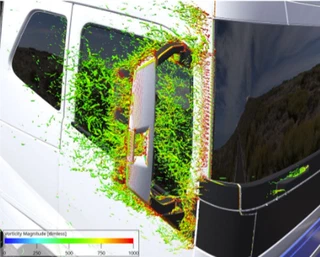
Image credit: Guleria et al. 2025
Abstract
The transportation and mobility industry trend toward electrification is rapidly evolving and in this specific scenario, wind noise aeroacoustics becomes one of the major concerns for OEMs, as new propulsion systems are notably quieter than traditional ones. There is, however, very limited references available in the literature regarding validation of computational fluid dynamics (CFD) simulations applied to the prediction of aeroacoustics contribution to the noise generated by large commercial trucks. Thus, in this work, high-fidelity CFD simulations are performed using lattice Boltzmann method (LBM), which uses very large eddy simulation (VLES) turbulence model and compared to on-road physical tests of a heavy-duty truck to validate the approach. Furthermore, the effect of realistic wind conditions is also analyzed. Two different truck configurations are considered one with side mirror (Case A) and the other without (Case B) side mirrors. The main focus othis work is to assess the accuracy of the commercial CFD software PowerFLOW to predict greenhouse wind noise analysis for heavy vehicles as a tool to complement or replace physical testing during the vehicle design process. From this study, we found that external microphone measurements at the passenger-side glass demonstrate strong correlation with simulation results, highlighting the importance of including a typical level of on-road free-stream turbulence to achieve accurate sound pressure level (SPL) correlations for the full frequency range available from the physical test (i.e., 100 Hz to 2000 Hz) for both configurations.
Type
Publication
SAE International Journal of Commercial Vehicle
Status
Peer-reviewed Open access
publications
Nicolas Fougere
Authors
Senior Manager Role Portfolio

Nicolas Fougere helps global manufacturers turn emerging technology into commercial strategy. As Senior Manager for the Fluids Portfolio at Dassault Systèmes, he sets the 3-year strategy for a multi-product CFD portfolio, owns the productization and pricing models decisions, and leads the portfolio’s shift toward AI enabled simulation.

He came into this role after eight years in technical sales, where he served as account lead for some of the company’s largest customers. That work gave him a close view of how large organizations actually decide to adopt new technology, which is a big part of why his current strategy work tends to hold up once it meets a real customer.

Earlier still, he worked on mission analysis and simulation research supporting NASA and the European Space Agency’s Rosetta mission, and published more than 40 peer-reviewed papers along the way. His engineering and scientific degrees are from the University of Michigan.

What distinguishes Nicolas is the ability to move fluidly between deep technical work and business decision-making, from a simulation review with engineers to a pricing or roadmap discussion with executives. That range is increasingly what organizations need when deciding whether a simulation or AI investment is worth making.