Design of a low cost mission to the Neptunian system

Aug 1, 2014·
Nicolas Fougere
Nicolas Fougere
,
Alibay et al
· 0 min read
Image credit: Alibay et al.
Abstract
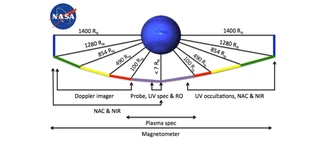
Visited only by Voyager 2 in 1989, Neptune and its moon Triton hold important clues to the formation and evolution of the solar system and exoplanetary systems. Neptune-sized planets are the most commonly discovered exoplanets to date. Neptune, an ice giant, is theorized to have migrated from its formation location in the early solar system. This migration affects the expected interior structure, composition, and dynamical evolution of the planet. Triton is conjectured to be a heavily-processed, captured Kuiper Belt Object (KBO), a remnant from the early solar nebula and unique in our solar system. Triton may possess a subsurface aqueous ocean, making it an important astrobiological target. The 2013–2022 Planetary Science Decadal Survey identified a number of high priority science goals for the Neptunian system, including understanding the structure, composition, and dynamics of Neptune’s atmosphere and magnetosphere, as well as surveying the surface of Triton. Following these guidelines, we present a low cost flyby mission concept to Neptune and Triton called TRIDENT (Taking Remote and In-situ Data to Explore Neptune and Triton). TRIDENT would carry six instruments and a government furnished atmospheric probe and would provide significant improvements over the scientific measurements undertaken by Voyager 2.
Type
Publication
IEEE Aerospace Conference
Status
Peer-reviewed
publications
Nicolas Fougere
Authors
Senior Manager Role Portfolio

Nicolas Fougere helps global manufacturers turn emerging technology into commercial strategy. As Senior Manager for the Fluids Portfolio at Dassault Systèmes, he sets the 3-year strategy for a multi-product CFD portfolio, owns the productization and pricing models decisions, and leads the portfolio’s shift toward AI enabled simulation.

He came into this role after eight years in technical sales, where he served as account lead for some of the company’s largest customers. That work gave him a close view of how large organizations actually decide to adopt new technology, which is a big part of why his current strategy work tends to hold up once it meets a real customer.

Earlier still, he worked on mission analysis and simulation research supporting NASA and the European Space Agency’s Rosetta mission, and published more than 40 peer-reviewed papers along the way. His engineering and scientific degrees are from the University of Michigan.

What distinguishes Nicolas is the ability to move fluidly between deep technical work and business decision-making, from a simulation review with engineers to a pricing or roadmap discussion with executives. That range is increasingly what organizations need when deciding whether a simulation or AI investment is worth making.