Aerodynamics for Design Styling Exploration for Vehicles - CATIA Webinar

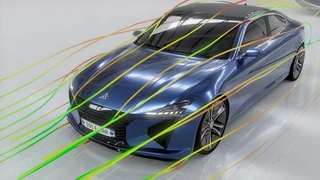 Image credit: [CATIA - Dassault Systemes]
I took part to a session that explores how aerodynamic simulation can be integrated directly into the early vehicle design process to support more informed styling and engineering decisions.
As vehicle electrification increases the importance of aerodynamic efficiency for range and performance, OEMs face growing challenges in balancing aesthetic intent with engineering constraints. Traditional workflows often introduce delays and disconnects between simulation and design teams.
This discussion presents an approach where rapid aerodynamic insights are brought directly into the design environment, enabling earlier trade-off evaluation between styling and performance. The goal is to support more informed, iterative decision-making during the concept phase of vehicle development.
The work reflects a broader shift toward embedding simulation and physics-based intelligence into the design process to improve clarity, reduce iteration cycles, and support better system-level decisions in automotive development.

Nicolas Fougere helps global manufacturers turn emerging technology into commercial strategy. As Senior Manager for the Fluids Portfolio at Dassault Systèmes, he sets the 3-year strategy for a multi-product CFD portfolio, owns the productization and pricing models decisions, and leads the portfolio’s shift toward AI enabled simulation.
He came into this role after eight years in technical sales, where he served as account lead for some of the company’s largest customers. That work gave him a close view of how large organizations actually decide to adopt new technology, which is a big part of why his current strategy work tends to hold up once it meets a real customer.
Earlier still, he worked on mission analysis and simulation research supporting NASA and the European Space Agency’s Rosetta mission, and published more than 40 peer-reviewed papers along the way. His engineering and scientific degrees are from the University of Michigan.
What distinguishes Nicolas is the ability to move fluidly between deep technical work and business decision-making, from a simulation review with engineers to a pricing or roadmap discussion with executives. That range is increasingly what organizations need when deciding whether a simulation or AI investment is worth making.